Download books about Oakland here.
Electronic versions of The Valley of Homes, The Years Between and Remembering Old Oakland, are available for download, thanks to Mr. Kevin Heffernan, an Oakland resident and author. Note: The two books are out of copyright and Oakland Historical Society has been given full permission for unrestricted use for the presentation made by Mr. Heffernan at the Oakland Library in 2006. Click on the icons below for the item(s) you wish to download.

| The Valley Of Homes |
| The Years Between |
| Remembering Old Oakland |
These books can be downloaded for your own personal reading enjoyment.
They are original books written by former residents Ryerson Vervaet, Shirley Iten Kern and Eleanor Steinberger Little in the 1950's and 1960's. Remembering Old Oakland was written with the help of documents and photos provided by the Oakland Historical Society, Inc.
Oakland's World War II personalities
Arthur Vervaet served his country from 1941 to 1946 as an officer in Combat Intelligence. He was awarded 3 Purple Hearts and a Bronze Star for gallantry in action. Arthur (aka Bud) moved to Oakland when he was 3 years old in 1917. In his early 20's he had already become a Boy Scout Troop leader for a troop of 44 boys. He was also involved with the Planning and Zoning Boards of Oakland. Following his return from combat duty, he became Mayor of Oakland in 1951 and organized the first Oakland Recreation Committee. He was also elected to the General Assembly of New Jersey in 1951 where he was Chairman of the Appropriations Committee and Chairman of the Highway Committee. Bud may have set a record when in one year he introduced 21 bills - all of which were enacted into law. In 1958 he was elected to the Board of Chosen Freeholders and became a member of the County Planning Board and Chairman of Public Works. Bud Vervaet was Director o the Board of Freeholders in 1964. He had been a protegee of Mayor Clifford MacEvoy who was mayor from 1936 to 1941. Mr. MacEvoy's wife was Bernice (nee Ryerson) and their daughter, Ryerson Vervaet, was the author of The Valley of Homes. So the commitment of Vervaet and MacEvoy families to Oakland was as strong as that of the Ryerson family. Martin Ryerson was Mayor in 1912 - 1913 amd George Ryerson was one of the first settlers in 1695.
Bud Vervaet's continued allegiance to Oakland was again proven in 1954 when his niece, Connie Williams (Mrs. Monks) became one of the first members of the Oakland First Aid Squad. Connie's parents, Mr. & Mrs. Herbert Williams were both very involved in Borough activities such as sports and the schools. Arthur Vervaet owned the Vervaet Woven Label Company at the corner of Franklin Ave and Rt. 202 across from the Van Allen House. He had bought the building from Edward Page's family, who owned the Van Allen House and the Vygeberg Farm in 1921. Bud Vervaet always supported Oakland's heritage.
Bud Vervaet's continued allegiance to Oakland was again proven in 1954 when his niece, Connie Williams (Mrs. Monks) became one of the first members of the Oakland First Aid Squad. Connie's parents, Mr. & Mrs. Herbert Williams were both very involved in Borough activities such as sports and the schools. Arthur Vervaet owned the Vervaet Woven Label Company at the corner of Franklin Ave and Rt. 202 across from the Van Allen House. He had bought the building from Edward Page's family, who owned the Van Allen House and the Vygeberg Farm in 1921. Bud Vervaet always supported Oakland's heritage.
The Colony
Did you know there was a summer colony where the same families came every summer to vacation? Read about The Colony of "West Oakland", as it was called, in the Oakland Journal...
For 350 years farmers have tended the fields, and enjoyed the natural resources of our rich community. From iron mines and a timber & charcoal industry to a Garden State throughout suburbia, Oakland has been a center for family living and working to survive, and survive well. Come see our farming and working tool collection from ages past, outdoors and inside. Learn about the agricultural power of the Stream House.
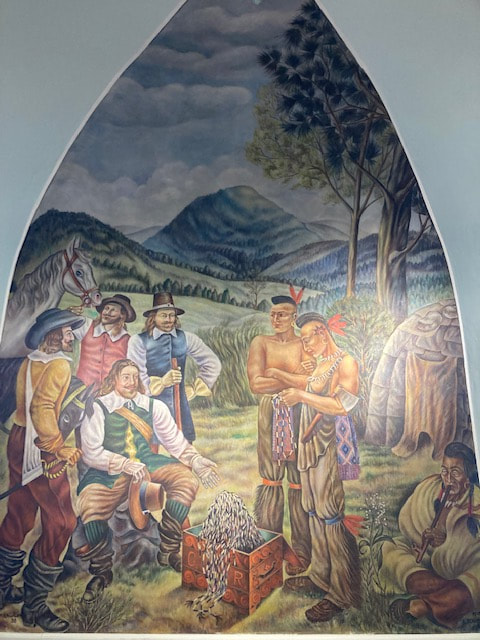
Learn how the Dutch settlers found out about local sources of iron-ore from the Lenapes back in the 1690's. After the British made the Dutch leave New Amsterdam (New York City), they continued to thrive up in Albany and throughout NY State. NY governor Pieter Schuyler's son Arendt became friendly with local native tribes, and convinced them to show him hematite sources in the Ramapo Mtns. from Pompton Plains up to Sloatsburg and beyond. Sloatsburg is dutch for "borough of furnace smoke-stacks." Pompton Lakes still has the remains of a colonial era stone iron ore furnace in the woods near the lake. A lot of Dutch settlers were very busy making charcoal, building forges and furnaces, and creating large quantities of pig iron starting at 1695. The women were busy tending the farms and young families. Want to learn more? Come visit us at the next open house.
For 350 years farmers have tended the fields, and enjoyed the natural resources of our rich community. From iron mines and a timber & charcoal industry to a Garden State throughout suburbia, Oakland has been a center for family living and working to survive, and survive well. Come see our farming and working tool collection from ages past, outdoors and inside. Learn about the agricultural power of the Stream House.
Learn how the Dutch settlers found out about local sources of iron-ore from the Lenapes back in the 1690's. After the British made the Dutch leave New Amsterdam (New York City), they continued to thrive up in Albany and throughout NY State. NY governor Pieter Schuyler's son Arendt became friendly with local native tribes, and convinced them to show him hematite sources in the Ramapo Mtns. from Pompton Plains up to Sloatsburg and beyond. Sloatsburg is dutch for "borough of furnace smoke-stacks." Pompton Lakes still has the remains of a colonial era stone iron ore furnace in the woods near the lake. A lot of Dutch settlers were very busy making charcoal, building forges and furnaces, and creating large quantities of pig iron starting at 1695. The women were busy tending the farms and young families. Want to learn more? Come visit us at the next open house.
Doty Road Bridge
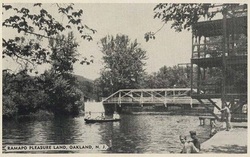
“The bridge was named after the Doty family, early settlers in Oakland Borough, Bergen County, N.J. The original bridge was 80 feet long and constructed in 1891 and spanned the Ramapo River in an area traditionally referred to as the ponds,” said Rakos. Continue reading the article from the US Army Corps of Engineers...
Below is the painting in Oakland's Public Library representing Arendt Schuyler and his Dutch Compatriots, Ryerson, Mandeville and others, meeting with local Lenape Natives for the first time in Northern NJ. The natives knew where sources of iron ore could be found along the Ramapo River and in the Ramapo Mountains. The Lenape didn't understand the value of the ore. They only used it as a pigment for their painting. The Dutch offered them shell trinkets for the right to take the ore. Then began our local history of towns along the Ramapo becoming mining towns. The ore veins stretched up into the mountains of Ringwood and a very lucrative industry began. This is described in the Years Between and in other original source books.